82
Opportunities mapped
 Brand Nexus AI
 Brand Nexus AI
Scale, brand, distribution, the relationships that took a generation to build. Every one of them is getting cheaper to copy each quarter. What replaces them is an operating model with AI underneath it, and it is being assembled right now inside somebody's company. Probably not yours yet.
We have helped dozens of enterprises become AI native. We design the operating model and we build the systems, and we have watched the value compound from there.
Every company we walk into shares a long list of problems, and these six come up every time. Every one of them is ordinary and every one is well known. What is surprising is how they got there, and that comes later.
A retailer, a distributor, a broker, an employer, a platform, a channel partner. Most of what you sell reaches a person through somebody else. By the time a signal reaches you it is a quarter old and it is another company's summary of it.
Buyers build the shortlist by asking an AI before they contact anyone. Candidates and partners do the same. You either come back accurately or you do not come back at all.
Neither of these is a problem you can outspend.
The forecast, the pipeline, the workforce plan and the segment all describe a company and a customer that have moved. Nothing tells you which half is wrong.
The close, the quote, the screen, the exception. Work that runs the same way every time is done in sequence, by people waiting on each other. Opportunities close faster than the process moves.
Why the deal was won. What the vendor conceded last time. How the process actually runs. It sits in files, inboxes and heads, and when the person leaves it goes with them.
The spend sits across agencies, licences, contractors and people's time. No single line tells you what a process costs to run, so nothing gets fixed against evidence.

Six problems, and they are the ones you already know about.
You already know every one of them. Here is what the market sells you against them.
Every one arrives with its own system, its own workflow, and its own line of fixed cost.
The organization comes out more fragmented than it went in, and the work goes up rather than down. Six purchases, and a company exactly as smart as it was before.
Your company is not built to get smarter. Everything on that list is a symptom of it.
Everything after this is a means. There is one end, and it is value that compounds. If a piece of it does not lead there, we would not build it.
Adding AI to the tools you already run gets you faster versions of the work you already do. That is worth something and it is not this. What follows is the operating model underneath, and the order it has to be built in.
What one team learns never reaches the next. The islands do not touch.
Half of it describes a customer who has moved on, and nothing tells you which half.
Locked in a system nobody queries, or in a head that is in a meeting.
When someone goes, the reason the decision worked goes with them. Decades of operating, and almost none of it accumulating.

That is not a failure of your people. They were never given anywhere to put it.
Four islands of what you know. What one team learns never reaches the next.
Join them and the islands become one graph. Current, connected, open to anyone who asks.
The same three people leave. This time nothing goes with them.
Most companies already have a name for this, invented years ago by their own people for the thing they wished existed. Use yours.
A result lands in one part of the business.
It becomes a recommendation in another, wherever the same conditions hold.
Then it does that everywhere at once. Nobody drew those lines. Nobody was in all of those rooms.
An org chart sorts people by who they report to.
The unit of analysis moves from the department to the work.
Four bands. Every one has a human in it. What changes is what the person is for.
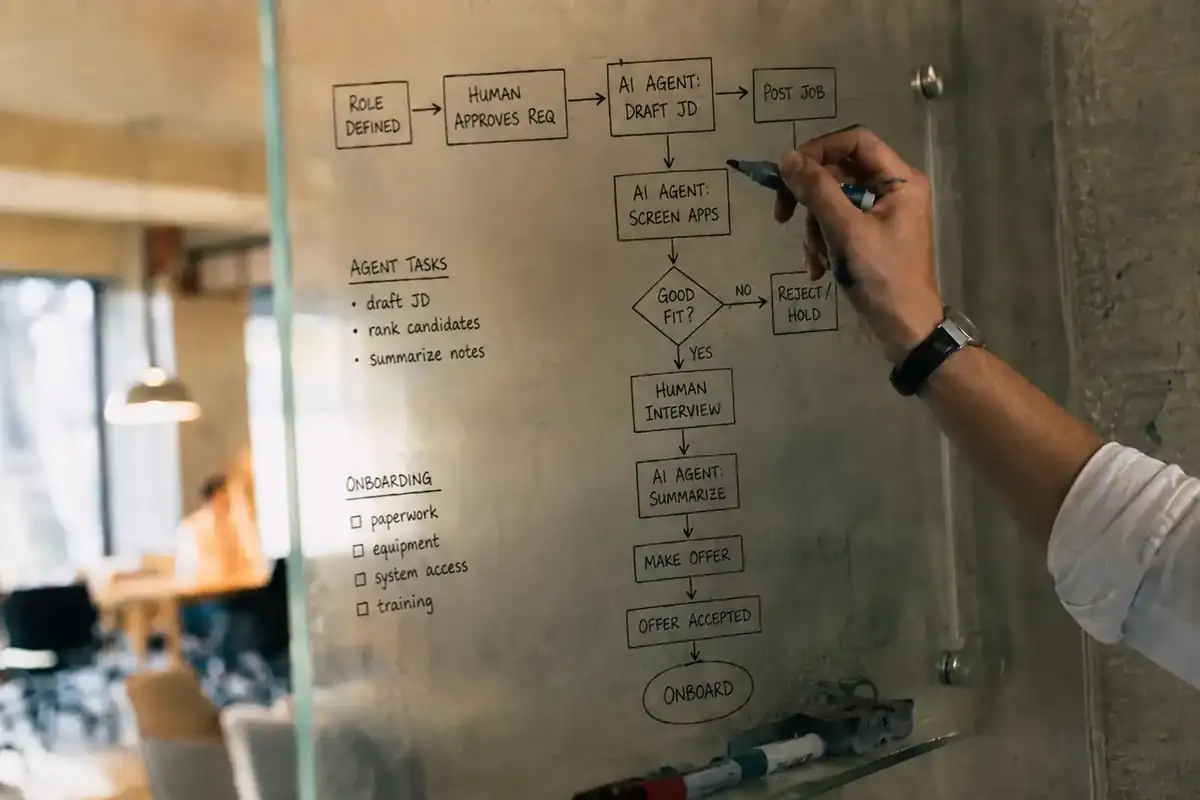
Every band has a human in it. What changes is what the person is for.
Agents do the work, at whatever volume you need.
Every path out runs through someone qualified to judge it.
An expert in the loop, not a human in the loop. A generic approver waves work through and catches nothing.

An expert in the loop, not a human in the loop.
Most companies think going AI native means buying tools and giving everyone a seat. That is the fastest way to spend real money and change almost nothing. It is an operating model your people lead and the company owns. Five beliefs shape how we build it.
Whatever model is ahead this quarter, you rent it, and so does everyone else. Next quarter the ranking flips. There is no advantage in the brain.
Persistent memory you own and control. A competitor can buy your tools. They cannot buy what you have learned.
Remembers what happened, when, and who did it, so nothing is lost when someone leaves.
Learns from every engagement and every signal you feed it, and turns that into compounding value.
Whatever is ahead this quarter, you rent it and so does your competitor. What you own is the memory: what happened, when, who did it, and what came of it. That is the asset, and it is the one thing a competitor cannot rent.
Do not pour what your company knows into someone else’s platform, where they keep the memory that compounds. We have watched a company build months of work on a single model and lose access when the vendor changed terms. The work stranded overnight.
Faster and cheaper is the smaller half. The bigger half is that the signal reaching your customer comes back, lands in memory, and belongs to every part of the business. One team runs the test. The whole company has the answer.
Judge every build by whether it makes the next one cheaper and whether it feeds what you know. If it does neither, it is a project rather than a capability.
The tool should bend to how your business runs. What usually happens is the reverse. The workflow gets rebuilt around what the platform supports, and the company inherits somebody else’s operating model by accident.
Decide the operating model first and choose the tools against it. That order is the whole difference.
Buying seats changes who has access. It leaves untouched who does what, in what order, with what checks. Roles, workflows and governance are the redesign, and they are the part nobody sells you.
Budget for the redesign, not just the licences. The licences are the small number.
The technology is the part that works. The hard part is several hundred people changing how they do their jobs, with their incentives, their tooling and their managers all pointing the same way.
If the plan has no adoption workstream, it has no plan. Assume the majority of the effort sits there.
Both companies run the same number of them. Same year, same budget, same people.
The other starts over every time, because nothing it worked out last cycle survived into this one.
Faster is an idea reaching the market before the quarter turns. Cheaper is the cost of running the business, not a line you trimmed once.
And the gap widens without anyone managing it. By month twelve the two companies are not competing on the same curve.
Every client is anonymised. The figures are as delivered.
Assessment at scale, and the first build out of it.
Decades of operating knowledge sitting in files, decks and people's heads, and no way to act on any of it at portfolio scale.
We mapped eighty two ways to be faster, cheaper and better across the business, and scored every one on value, feasibility and what it unlocked downstream.
One line, in one function, out of eighty two.
A single deep intervention, with revenue attached.
Half the prescriptions written for one drug were never filled. Patients got confused partway through the process and stopped, and nobody knew which patients until it had already happened.
We built the ability to spot at-risk patients before they dropped out, with guidance where guidance was enough and a referral to a nurse practitioner where it was not.
The agent did not replace the nurse. It found the patients the nurse never knew were in trouble.
An intermediary hiding the end customer.
The company could not see its own customers. An employer sat in the middle of every relationship, so the people using the product were invisible to the company selling it.
We identified who those customers actually were and built the ability to reach them directly with something relevant.
An intermediary standing between a company and its customer is the most common version of this problem, and it is rarely the one being worked on.
What we build is specific to your business. It starts with a deep assessment of where the value actually is. Not a survey. A hard read on how the work moves today, and on where the money is already going.
For a company of any size that can be as many as a hundred opportunities. Every one scored on business value, on feasibility, and on whether it unlocks anything downstream. Quick wins, major projects and moonshots side by side, so the choice gets made against evidence rather than instinct.
The first three get architected. The one we sequence first usually scores highest on value and lowest on feasibility of anything in the wave. It is the hardest thing to build and it demonstrates the worst, and it still goes first, because everything after it gets cheaper.
All three sit on the same memory. Which is why the second costs less than the first, and the third costs less than the second.
Six to twelve weeks. Every stage ends on something usable.
Week two you see your own operation clearly. Week eight the memory starts and the curve begins. By week twelve your team is running the cycle without us.

Compounding starts the day the memory starts.
Every month without it is a month of learning thrown away. You cannot buy those months back, and you cannot catch up by spending more.
The Accelerator is where most engagements start. Here is the rest.
Enterprise teams trained in generative AI, from executive fluency to working practice. Runs before an engagement, inside one, or on its own. A hundred and more enterprises have been through it.
When a prioritized opportunity needs building, we architect the system and stand it up with your team or with a build partner. You own it.
The leadership rather than the build. For companies that know what they need to do and need someone accountable for it inside the business.
Architecture stays current as models, governance and the vendor landscape shift. Strategic, not operational. We are not running your platform.
Strategy, architecture, engineering, change management, facilitation. We assemble against what the work actually needs, so you are not paying for a bench and you are not waiting on one either.
Founded by Pedro Laboy, previously a Managing Director at Accenture.







You need to do these things whether you do them with us or not.
Tell us what you are trying to accomplish this year, and we will work backwards from it.
Brand Nexus AIWe will work backwards from it.
Cross-industry AI transformation. We design the operating model and we build the systems. Speaking and advisory at pedrolaboy.com.